What is Project Based Learning?

What is Project Based Learning?

Over the years I have heard the phrase “project based learning” and have spoken with several teachers who have boasted about having a being project based learning (PBL) classroom. As I have had the opportunity to visit different learning environments it has become clear that there are some misconceptions about PBL. I do not claim to be an expert by any means, but I have done quite a bit of research on how to structure your classroom into one that lays a foundation for learning through inquiry and project based strategies that lead to authentic learning.

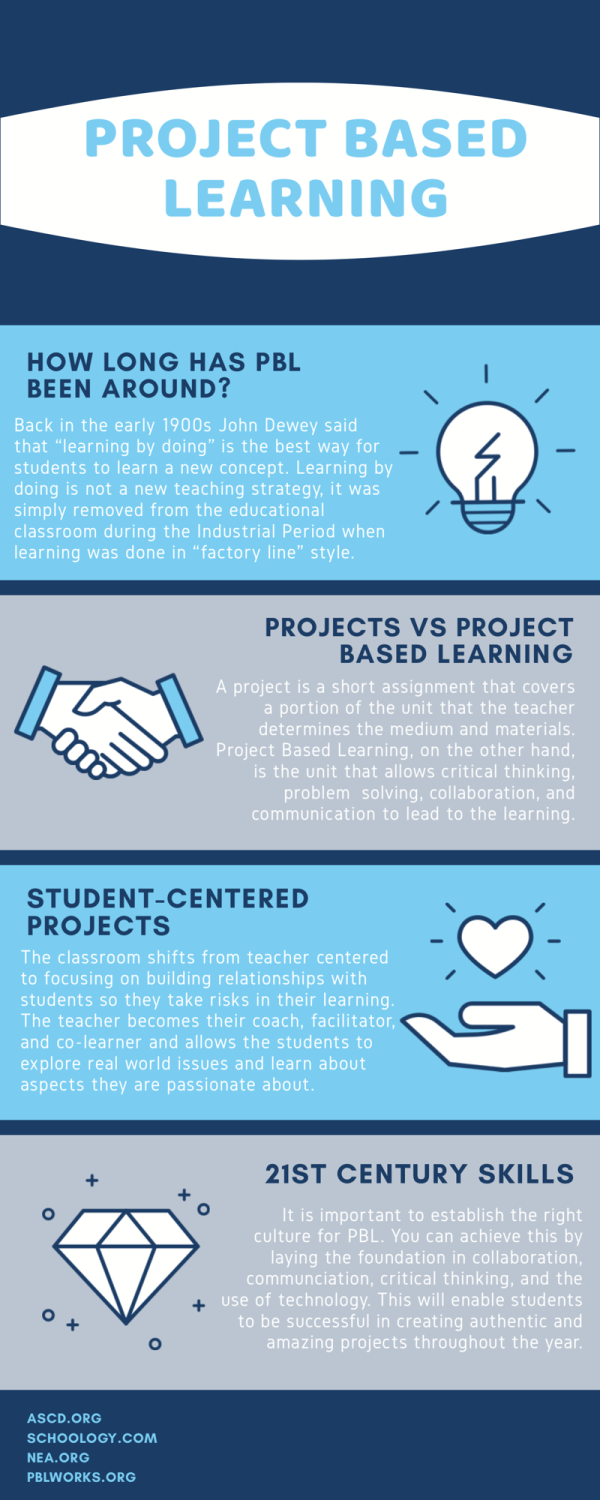
I have created a few infographics to share what I have learned so far about PBL. Feel free to download and share! The first image shares the origin of PBL and why it is an important style of learning that should be used in the 21st century classroom.

The second infographic is seven essential characteristics to have a successful project based classroom.

PhotoVoice: Giving a Voice to All

PhotoVoice: Giving a Voice to All

For the past 3 years I have gotten to work with a range of English Language Learners (ELLs). Not only do these students come in with a variety of different home languages, but they also bring their own unique story to my classroom. As an educator it is my job to give each of these students a voice to share their story. The main way I can do that is by helping them acquire English. The catch is, learning a new language takes years and a ton of hard work. I wanted to find a way to give my students a voice right now.

The Build Up

I had the opportunity to go to Montana for a sustainability conference a few summers ago and it was life changing. Not only for how I approached my work in the classroom, but also in the way I viewed every day life. I decided to live with purpose. Through out the course I was given several strategies to take back to my community to build awareness and help educate people on the sustainability struggles our world is facing today. One of my favorite parts of the conference was the presenters did not say we all need to stop driving cars, we need to only eat organic food and absolutely not meat, and no more toilets because of the water waste. Instead they gave practical solutions in areas that every single person can do. I will share those tips in a later blog.

What About Giving a Voice?

One of the strategies to help students put into words how they feel about the current state of our environment is to not actually make them say or write it down, but rather, to show it through pictures. This got me to thinking, what if I could do this with my ESL students. They can show me through pictures what matters most to them and their families. I did more research on this topic and a school district in Colorado had the same thought. Their approach was to have a select group of parents who were given cameras and asked to take pictures about their lives and cultures to share with the school. This was built into an adult literacy program to help the parents learn English along side their children.

I decided to take it a step further by giving the vision to the children. Let the students talk with their parents and decide what matters most to them. So I did just that and here are the steps. Disclaimer- I am going on year three of doing this and have changed steps drastically each year as I have seen what has and has not worked. I am looking forward to sharing how this years project goes.

Step 1

I wrote out a project summary and rubric. The purpose of this project is for me to understand my students and their families better. Each student is required to take a minimum of 10 and a maximum of 20 photos that show what they value in life. I encouraged students to complete a portion of the photos with their parents and secretly hoped this could spark some meaningful conversations about heritage between the students and their families.

Step 2

I went out and bought five digital cameras. My original plan was to get disposable cameras for the nostalgia of it, but then decided this was impractical. Now, these digital cameras are not fancy by any means. I purchased water proof/shock resistant Polaroid cameras for 45 dollars a piece. Handing these to my students was hilarious since none of them had used a camera before, they had only taken pictures with their phones. After a quick mini lesson on how to take pictures and delete the ones they did not like I sent them on their way. They had one week to take their pictures.

Step 3

Once students turned the cameras back in I uploaded them to my computer and created shared google folders between myself and each student with his/her own photos. Now it was time for the students to write a summary or explanation of what the photo represented and why it was important to them. I provided sentence frames for my each of my students to help them get started. This step took the longest as each of them had around 15 pictures to write about. I would suggest planning a few weeks of allowing students to work on these. My class is a Seminar style class so they had to fit in working on these around other commitments.

Step 4

Presentation- my favorite part! Each student had a choice of what format to use for the presentation. I suggested things such as a video/slideshow, a poster board/desk top presentation, and I provided clothes pins for them to clip the pictures up throughout the classroom. It was so much fun to see their creativity blossom during this part of the process. Each project was unique and truly a representation of their story.

Step 5

This last step is optional as each of these stories is the students own story to tell if they chose to. I took a new job this year as an ESL designee a school district and I work in two specific buildings. Once my new group of students have finished the project this year I plan to have a family night at school to allow the students the opportunity to share what they have down with their families and any school employees who wish to participate. In previous years I have only done a small classroom presentation, but decided it was time to share their beautiful experiences with anyone who wants to be a part of it.

Next Steps

I will be writing another blog after this years projects are finished and share the pros and cons of this latest sequence of steps. For now I am happy to be doing everything I can to give all children a voice.

Teachers vs. Everyone: Media’s Portrayal of Educators

Teachers vs. Everyone: Media’s Portrayal of Educators

30 years ago Robin Williams starred in the movie Dead Poet’s Society, which is still watched in classrooms today. In this film we see a teacher motivating his students to be the very best they can be. It’s a wonderful portrayal of an educator challenging and leading students to always do their best by seizing the day. It’s also an accurate representation of what an educator should be. It might not as romanticized as this Hollywood depiction, but it’s an educators job to connect with student and help them reach their potential.

But that was 30 years ago.

While the role of the educator is still the same thing, connecting with students, helping them grow academically, and preparing them for life, there has been a shift in the cultural identity of teachers.

Today, movies, television shows, and media in general represent teachers in a less glamorous way than they were depicted 30 years ago. Teachers are portrayed as the adversary. They are inept or incompetent. They are morally corrupt, and they are the enemy.

This summer it was recommended to me that I binge watch the show “Big Little Lies”. If you have not seen this show yet it has an all star cast with Reese Witherspoon, Nicole Kidman, Laura Dern, Meryl Streep, Shaliene Woolley, Zoe Kravitz, and many more amazing actors and actresses. I was intrigued by the line up alone, so I figured why not.

About 20 minutes into the first episode a first grade teacher calls an impromptu meeting with the students and their parents. She says that the day has been great, but a student has hurt a fellow classmate. She then has the victim stand in front of everyone, and asks for the attacker to step forward. When no one comes forward the teacher then asks the little girl to point to whoever hurt her, which she did.

The mother of the accused child (wrongly so we find out a few episodes later) was outraged as was the mother of the victim. All the parents were talking about how the teacher handled the situation and how awful it was.

Throughout the series there are several situations in which the principal and teachers act inappropriately and speak to parents in ways that I would never speak to another person: especially not in a professional setting. The show is not based around the students in school and quite frankly the principal and teachers have very small roles. This is why it bothered me so much that the educators were displayed as incompetent and unprofessional in so many ways.

While driving around with my husband I brought up my take away from the show and how the educators were portrayed. This lead to a lengthy discussion about teachers and principals being the antagonist in shows, movies, and the media and trying to decide why that is.

Big Little Lies is just one example. The negative portrayal of educators in media has become the new normal. This portrayal shapes the way society views educators. When people see teachers demonized in Hollywood it teaches them to treat educators as the enemy. I plan on writing a more data-driven paper in the near future. I just wanted to get my thoughts out there and get feedback from fellow educators, parents of students, former students, and current students as I move forward.

The Goldilocks Zone

The Goldilocks Zone

In science, the Goldilocks zone refers to an area that is just perfect for human life to inhabit. This means the distance from the closes star is the perfect distance compared to the size of the star so that human life form can be supported. The temperature is not too hot or too cold. In these zones water can exist. There is not a set distance from any star. It depends on the type of the star, how large and strong the star is, and the rotations of planets around the star will shape the Goldilocks zone.

I could not help as my husband was describing this phenomenon to me that it sounded a whole lot like the type of environment we try to create in the classroom. Teachers are trying find the Goldilocks zone for each of their students. The issue that we come across is that teachers are the star in the classroom and are trying to create Goldilocks zones for students that are in varying distances from the star. The teacher (star) is to provide the instructional pedagogy and practices for each student in the room. Teachers have personalities and ways that they teach best. Yet, we ask teachers to be able to change and adapt to the unique needs of every student in the classroom at all times. So the million dollar question is; how do we find the Goldilocks zone for all students?

Learning Targets

Finding the Goldilocks zone requires us to first define exactly what the zone is . For scientist the Goldilocks Zone is a distance from the star that is habitability by humans and a place that water can exist. This is the same with students; developing essential learning targets for each unit that are written in student friendly terms. These learning targets should be developed from the content curriculum and decided on by the collaboration team and vertical alignment. In 7th grade math the team may decide as a whole that every student needs to master scientific notation and make this a learning target. If this collaboration team also meets with 8th and 9th grade math teams they will either determine this is an appropriate learning target or is not necessarily a requirement for 7th graders have mastered to have future success. From there the team can decide if it should be a requirement so that all students are on that zone. Goldilocks zone does not limit extra things, for instance extensions in the classroom to challenge students, but discusses the bare minimum that must be there. That is the role of defining essential standards and learning targets.

Regular Formative Assessments

Scientist have to run several tests on each planet they may feel is in the Goldilocks zone to determine if it meets all of the criteria. In teaching, students should be exposed to regular formative assessments to gauge their understanding and to test where they are at throughout the year.

Specific Research Based Interventions

When a student is failing to meet the grade level standards then we know that we are not in their Goldilocks zone. Therefore, the teacher must adjust and provide appropriate interventions to meet those needs of each student. The regular formative assessments should provide information on exactly what needs are being missed. From that data, the teacher then must look into research and evidence based interventions that work best. Scientist don’t start throwing out random solutions to a problem without having exhausted best practices first.

Ask for Help

The last piece of advise is to not be afraid to ask for help. If you are a new teacher or a teacher who has been doing this for 30 years there is no shame in asking for help if you are struggling to find a student’s Goldilocks zone. There are large teams of scientists working to find inhabitable planets in space, not just one scientist. When asking for help it doesn’t even have to be within your building or your content area. One of the best things about the internet is how it has grown every educators “Personal Learning Network” or PLN. Twitter is a great place to search hashtags or look for educational gurus and search their works. I know I have learned so much through my digital interactions. Whatever can help me reach every child is worth doing.

Good teaching practices are all around us. Resources are available to teachers who want to continue to be a life long learner and to reach all students. Every students’ Goldilocks zone can be and should be found.

10 Activities for Active Recovery

10 Activities for Active Recovery

Earlier this year I wrote a post about Active Recovery for Educators. The blog highlights the need for not only recovery during times of rest, but active recovery. This term is mostly used in athletic settings. The idea is that an athlete should not take entire days off, but instead do lighter activities so their bodies are still recovering without completely taking off. This helps your body transition more easily from active to non-active and vice versa.

I can struggle with finding that perfect balance between active recovery, complete recovery, and completely active. I have been “off work” for a month now. In that month I have taken a graduate class, gone to a work conference for AVID in Dallas, attended my son’s baseball tournaments every weekend, and started remodeling the kitchen. Along with everything else I have also begun looking at ways to allow myself to recover from the previous school year and to actively prepare for the upcoming year. I decided to write down 10 ideas for fellow educators to engage in active recovery this summer with me that do not break the bank.

Read a Book

Throughout the school year I have several books that I am reading and studying to better serve my students. I love these books and can completely get lost in them. The summer is a good time to either get caught up on those educational books that piled up over the school year or to pick up a book that is purely for fun and for yourself. Listening to an audio book is another great way to get to more books than you may have time to actually sit down and read. My current audio book on my play list is Scott Westerfeld’s Uglies and I have quite enjoyed it.

Be a Tourist in Your Own Town/State

Two summers ago was one of my favorite summer vacations we have taken as a family and we did not even leave the state of Arkansas. I was born and raised in Arkansas and yet I had never gone down to Southern Arkansas and dug for diamonds which we are famous for. So after 28 years, my husband and I loaded up the car with camping equipment and both kids and headed out on an Arkansas vacation. It was so neat to see what all my state had to offer and to share that with my children. This summer we have spent our free time checking out local affairs, such as the free summer concerts series featuring The Dip at JBGB, volunteering at the BITE event in Bentonville at the BrightWater culinary school, and hitting up some local breweries. If you live in NWA you may not realize just how much there is to do here, we have stayed busy and yet barely scratched the surface of everything that is offered in this quaint community.

Develop a Workout Routine

This has been one of the harder parts of active recovery, but also one of the most rewarding. Every day I do something active; go on a bike ride, go for a run/walk, climb, circuit workout, hiking… I figure if I develop these habits now it will be easier to keep them throughout the school year. I will touch base again in October and share how my workout routine is going!

Try New Recipes in the Kitchen

Okay, so being honest, getting a home cooked meal on the table 5 nights a week during the school year is nearly impossible with my busy schedule. Add on to that my kids getting older and busier as well. This summer we are actively trying new foods and recipes and it has been such sweet time with my kids and I. We also tried Plated and was very surprised with how good the food is. We will be doing this throughout the school year so that we can keep up trying new foods without having to spend too much time picking out recipes and grocery shopping.

Learn a New Hobby

This summer I have taken on trying to learn how to sew. I had a pile of clothes that have needed to be hemmed or fixed. With technology such as YouTube you can learn just about anything, for instance, how to put a zipper back on its tracks if it has come off on one side.

Go Floating

More than going floating, getting outside is a huge part of active recovery for me. I need to be surrounded by natural beauty and soak up as much as a I can before the school year returns. Floating is my preferred way of getting outside because of the scenic views, little workout from paddling, the adrenaline rush of the rapids, and then the relaxation throughout the float.

Attending Educational Conference/Road Trip

During the summer is a great time to hone in your skills and learn new strategies for the upcoming school year. When choosing which conferences to attend it is always a good idea to start by looking at the cities you want to visit and go from there. Last summer I got to road trip to Chicago for a Pre-AP conference, New Orleans for a Solution Tree RTI conference, and recently returned from Dallas attending an AVID conference.

Do a DIY Project in Your Home

I can tell you from personal experience of what NOT to do, do not pick too many projects the day you get out of school. You will end up with a garage full of old pieces of furniture, old appliances, new appliances, wet saws, back splash pieces, new light fixtures, and all of the things that are typically in the garage minus your vehicles. When doing home improvement projects make sure to do one at a time. Make a list of priorities at the beginning of the summer and then begin ticking them off as you go, only starting a new one when the one before is finished. This will help keep you and your family sane for the summer.

Garage Sale

I never realize just how much stuff we accumulate throughout the year until it is time for Summer Cleaning. **There is no such thing as spring cleaning when you are a teacher, spring time is for testing and survival mode. So once you have gone through the house and pulled out all of the things you do not need go ahead and have a garage sale. This will help bring in a few extra dollars and will make you happy with the newly cleaned and organized house.

Participate in Educational Twitter Chats

This last one is my new favorite and is completely free! There are always educational twitter chats going on that anyone can join. My three favorites are #edchat, #edtechchat, and #LeadUpChat. With twitter you can always search a topic you are interested in and find great resources and meet new people to follow. Summer time is a time to learn new technology if you are not used to it and prepare for the following school year.

The 21st Century Student

The 21st Century Student

“For the times they are a-changin'” applied when Bob Dylan wrote and released them in 1964 and the words still apply today. Some may say they apply more now than even.

Education is at a point where demands have never been higher and stress on both teachers and students are at a breaking point. Strikes across the countries have broken out asking for more pay so teachers no longer have to work three jobs along with being a full time teacher just to pay the bills. College tuition and student loan debts are at an all time high and the scholarship pool is getting more demanding of children. Celebrities are doing what ever it takes to get their child a spot at a premier college while children of immigrants are left not knowing if they can remain in the country once they turn 18.

As a teacher in this world I am always looking for how I can prepare my students the most so they can be successful in the 21st century. Schools are changing to reflect a PLC model that maximizes collaboration and minimizes isolation, standardized assessments rigor are growing each year, proficiency is being redefined regularly, schools are implementing Social Emotional Learning that all teachers need training on, and much more. With all of these changes it can be hard to know what is best to focus on while trying to equip my students for post high school life.

As the 2018-2019 school year is wrapping up I always try and reflect on my highs and lows. While doing some research I came across an article about assessments and the need to bring hope, efficacy, and achievement back to the classroom. In this article I learned about the “COTE of armor” for helping students become their best and must successful selves. C-confidence, O-optimism, T-tenacity, and E-enthusiasm. This article also went on to explain the six tenets of using assessment to build hope, efficacy, and achievement in the classroom which was very intriguing, but I could not stop thinking about this COTE of armor.

While contemplating the state of our country and seeing how heavily divided it is in all areas, I want to find a way to unite people and help my students be the movers and shakers of the next generation. Those four characteristics are not only what is needed in the classroom to be successful, but also in life.

As I move into my summer break I will take the time to prepare myself mentally and physically for another school year. But, I will also spend part of my summer researching ways to instill courage, optimism, tenacity, and enthusiasm into all of my students. I look forward to sharing my successes and setbacks with you all. I may not master teaching the 21st century student in the 2019-2020 school year, but I will put on my COTE of armor every day; helping educate and prepare our future leaders.

COTE

Feedback: how are we really doing?

Feedback: how are we really doing?

Teacher evaluations can be a stressful topic in schools. Personally, I look forward to walk-throughs from my administrator. It is a time for an outsider to come in and give me a different perspective on my classroom. I anxiously look forward to my feedback as it provides insight on areas I can celebrate and areas I can grow in.  I only wish I got to have continuous feedback throughout the year so I could see and track my progress over time. As an educator, that is exactly what we should be doing with students; proving ample opportunities to receive feedback and to show growth.

So, as educators in all positions, how are we really doing on feedback? Studies have shown that the way a teacher approaches feedback will greatly effect each student’s learning. While attending a Solution Tree RTI at Work conference in New Orleans, Nicole Dimich Vagle spoke on feedback and the huge impact it has on student achievement.

Grading assessments, whether formative or summative, should give the teacher AND student a deeper understanding of the misconceptions that have occurred. This means that assessments should be designed with a specific purpose and end goal in mind. Once the assessment has been designed and the students have taken it, the teacher must then decide how to provide feedback and ways for students to learn from their mistakes.

A study done for Classroom Assessment and Grading that Works by Mazarno shows us these staggering statistics:


Teacher Action: Only tell students number of correct and incorrect.

Impact on Student Achievement: Negative, student achievement decreases.


Teacher Action: Clarify scoring criteria.

Impact on Student Achievement: Increase student achievement by 16%.


Teacher Action: Provide explanations about why responses are correct or incorrect.

Impact on Student Achievement: Increases student achievement by 20%


Teacher Action: Ask students to continue responding to an assessment until they correctly answer the items.

Impact on Student Achievement: Increases student achievement by 20%


Teacher Action: Graph student achievement.

Impact on Student Achievement: Increases student achievement by 26%


Those numbers were shocking to me. I thought about all the times I only gave my students the number of questions they got right and wrong. For summative assessments I have always allowed test corrections, but it has only been in the last year that I have allowed for corrections on other assignments. After I got over the horrible feeling that I had failed all of my students, I started trying to answer the question “how can I do better?”

When I returned from the conference I knew that the way I provided feedback had to change. Not only did it have to change, but I could not wait until the next year to implement new practices; I had to start now. The first thing I have begun with is developing three student learning targets that I provide at the beginning of each unit. Students are asked each week to rate their understanding on those three targets. This is not the same as graphing student achievement, but it is a start.

After I created these learning targets I created three short formative assessments; no more than five questions on them for each unit. These assessments line up with the student learning targets and help provide not only myself, but also feedback to the students on their understanding of each target. These assessments are not put in the grade book; they are purely used for feedback and growth.

Eventually I would like to create rubrics for each of my formative assessments that students can self-grade and look for their own errors. My next goal will be to have students track their growth over the year towards overarching targets for the entire subject. All of this is a process that will take time. One way to tackle this workload is functioning in a PLC school. Working in a Professional Learning Community will divide up the work and actually make providing individual feedback more manageable. Individualizing feedback takes a lot of work, but it is well worth it and is invaluable to student growth.

Do You PLC?

Do You PLC?

The structure of schools have changed dramatically over the last few decades. In my blog Digital Age in Industrial Education I discuss how schools used to be designed around a factory line style of learning due to the type of jobs that were needed in the industrial period. These factor line jobs are no longer in high demand, therefore our school structure is changing to match how students need to be prepared for the world we live in now. The problem is some traditional parts of school have not kept up with changes as well as others.

With the change in schooling a lot of great evidence based practices have emerged to create the best learning environment for all students. One that I am very interested in and am continuing to learn about is Professional Learning Community (PLC). PLC function off of four driving questions:

  1. What do we expect our students to learn?
  2. How will we know they are learning it?
  3. How will we respond when they do not learn it?
  4. How will we respond if they already learn it?

Arkansas has started an initiative so that all schools use the PLC model within their schools. This requires a lot of planning and dedication by the entire school.

So– does your school PLC?

Expert Principal Interview

For a class assignment in graduate school, I had the opportunity to interview a principal at a model PLC school. Here is a piece of our conversation.

Me: “How do you ensure buy in from your staff as far as PLCs are concerned?”

Expert Principal: “We use the word commitment instead of buy in…”

I remember thinking that was such a strange phrase for the principal to make sure and correct me on. I listened as she explained that everyone had an opportunity to voice any concerns about the new PLC structure that was being implemented at her school. She made sure that all stakeholders where given the why and purpose behind PLC as well as clearing up any confusion: PLC is not an initiative. PLC is a way of structuring a school so that all students learn at high levels.

After this principal interview I went back and asked my professor why he thought she felt the need to make sure I used the word commitment versus buy in. I understood that technically they are different, but I have heard a lot of people use buy in when speaking about PLC. He chuckled which made me feel even more ridiculous, like I was missing some major concept about professional learning communities. Come to find out, I was.

Common Vocabulary

I have talked about common vocabulary in several different situations with my math students. Think of the words slope, rise over run, change in y over change in x, rate of change, constant change of proportionality… When you hear all of these words you know they mean the same thing, but there are certain times you would use rate of change that you would not use rise over run. Let’s take a more broad approach with words such as formative assessment, common formative assessment, summative assessment, common summative assessment, standardized test, high stake assessment… We understand that each of these are assessments used in different situations.  We may not know exactly how to define these– but we (hopefully) know which each of them are if we saw them in front of us.

Now imagine a school with 200 teachers and everyone is using a different word for the same concept, or at least they think they are talking about the same concept. How can you really know if you are talking about the same thing if words have not been clearly defined and communicated?

Back to my principal interview. My professor went on to explain that common vocabulary has to be one of the first things that a school does when implementing PLC. Just as every school should have a common mission and vision that all staff members are working towards, so should every school have common vocabulary for a consistent vision among the whole school. From this common vocabulary, the school can define their mission and goals for the Professional Learning Community.

Team Norms

Envision a school that has defined their common vocabulary and everyone is on the same page as far as the educational language to use and the goals of the PLC. It is time to start meeting together, with different faculty members, with different personalities, with different passions… Conflict can arise quite quickly without clearly defined norms. Educators expect students to abide by classroom norms so that all students can learn. Educators should be held to same standard of creating norms and each person respecting and upholding those norms.

Not every collaborative team will have the same norms just as not every classroom will have the same rules and procedures. Each team must take into account the personalities on the team and what ways to bring out the best collaboration. This allows the team to analyze student data that is driven by the four PLC questions.

A norm that I would suggest is defining roles within each collaborative team. These roles do not have to be set for the year. They can rotate every month or quarter; whichever works best for your team. Having set roles will help PLC time be purposeful and efficient to bring out the best practices from all teachers to achieve student growth.

Collaboration

Schools can spend all day defining education buzz words and creating the best norms for collaborative teams. None of that matters if the school does not foster a culture of collaboration. Collaborating takes time and commitment by the entire school. Everyone, even those who may not be teachers, must work together to provide time for teachers to continually collaborate and answer the four PLC questions defined by DuFour and Marzano.

Building a school with a foundation in PLC is hard work. It is not a one and done, but rather a process that should be reviewed and added to each year. Collaborating begins with prioritizing a common shared time for teams to work together. Once that time has been set aside then teachers must be conscious of that time and how to use it. While at the Solution Tree Conference, Luis Cruz did a session on collaborating versus co-blab-orating. The session centered around a commitment to set and respect norms that allows for the PLC time to be protected from venting and will focus on the four questions centered around student learning.

SMART Goals

When a school starts working on implementing and restructuring the school to be a PLC school it can be daunting. I was given the advice that when I read Richard DuFour’s articles and books on PLCs to remember he wrote most of those books after several years of practice. Starting out, we should not expect to be experts in the world of Professional Learning Communities.

Writing SMART goals may not happen the first year, but is an important part of the foundational work. Creating a culture of collaboration and establishing norms is the basis in which everything else is built. Once those are strongly established, then collaborative teams can begin with goals. Start small and define two to three SMART goals for the year. From there the teams can begin writing common formative assessments. Begin with one a unit, then each year add a new one. After a few years this will organically grow to multiple common formative assessments to track student achievement throughout the school year.

Do You PLC?

So, does your school PLC? I am by no means an expert. I am learning through my mistakes and will continue to grow with the guidance of others. The biggest piece of advice that I can give is be willing to commit 100% to this new structuring of schools. It will be hard work and will demand all hands on deck, but it is well worth it. Professional Learning Communities is not an initiative. Our society is changing, and therefore, so must education.


The New Problem Solver in Education

The New Problem Solver in Education

As a secondary math teacher I am constantly trying to teach my students how to be problem solvers. When a situation is presented, look for patterns from previous experiences, identify all of the pertinent information, and create a solution. This is a great skill to have and every student that graduates high school should have it mastered.

Once you are in the “real world” I feel that being a problem solver is no longer adequate. Yes, things will inevitably go wrong and people need to know how to fix them quickly and efficiently. What sets leaders apart is not just the ability  to solve problems quickly, but to be able to find the potential problem before it happens and to put actions in place to prevent it from ever happening.

I am quickly learning in my educational leadership classes that there are so many different facets to every potential issue. There will be problems that cannot be avoided. As a educational leader, whether that is as an administrator or teacher leader, it is your job to be able to identify potential problems and determine if there is a prevention that can be put in place. This is why it is best to surround yourself with people who have a range of different abilities. Every problem can look different to the person viewing it, therefore don’t try to tackle them alone. When approaching these issues be consistent with your approach; student impact should always be top priority, but also consider how your solution may affect stakeholders as well.

Building a team to help access problems will help make any educational leader’s life easier. Don’t just have the administration team look at these potential problems. Have teachers, students, parents, and community members examine them as well. These are all people who may be affected by the issue at hand. Education is the future, and everyone should be involved in defining the best way to educate the next generation.

Active Recovery for Educators

Active Recovery for Educators

I noticed something during this past Winter Break. Any time that I checked Facebook, Twitter, or any other social media platform I saw all sorts of memes about teachers relaxing. One of my personal favorites said that we have earned the right to be lazy the entire break. I couldn’t agree more.

As the break progressed I had to stop myself from working or reading my latest find about standards based grading. My husband would see me sneak away and find me sitting and working on my iPad… typing away on a new blog. Don’t get me wrong, I also discovered the joys of The Marvelous Mrs. Maisal while on break. I had plenty of lazy mornings and time spent doing absolutely nothing. Everyone needs time when they are not 100% put together. When I am at work I have to be completely there for my students. They need me to show up and be ready for them. Always.

During my down time I also got the chance to read several blogs I had been meaning to catch up on. Pretty much every single one I read leading up to the new year was about self care. I am so excited that self care is such a hot topic today among educators. Teachers have to make time for themselves.

When it comes to “self-care”; here is a reflection of mine over the past year.

Last summer I had several great opportunities come up. I got to go to Montana with a coworker for a sustainability conference, Fort Collins, CO with my family on vacation, and Chicago for Pre-AP training with college board. Since I had so many trips planned I felt like the rest of my time should be spent doing nothing. To me, all of this “doing nothing” between trips and my son’s baseballs tournaments was my self-care and relaxation.

During my winter break I took a different approach. Instead of approaching my self-care with “doing nothing”; I made plans. I visited family, I read books, I painted again, and I did so many activities with my kids. I very rarely spent time laying in bed and binging on Netflix.

With complete sincerity, when it was time to go back to work on January 3, I felt ready. I felt re-energized. I could attribute it to one thing: I did active recovery over the break.

Now, for some background. I was an athlete growing up. I played competitive soccer, softball, and basketball. I finished high school playing volleyball as well. Since graduating high school I have tried to stay active. I have done CrossFit, Barre, and various other workouts and have loved each of them. One term you may hear regularly in the athletic world is “active recovery”. To keep it simple this means on your days off, you still go do something like a walk or light jog. Don’t completely take off, but just make it light. This keeps the athlete from going from one extreme to another, they are always staying active. Just at different levels.

This philosophy can also be applied with teachers. The extreme highs and extreme lows can be difficult for a person to handle. When someone has been working 60+ hours a week and working with difficult students it can be hard to completely shut down and do nothing.  On the same line of thought, if a person has completely checked out then when it is time to go back to work it can be equally if not more difficult to adjust back to work life.

This is why I suggest active recovery for teachers. Spring Break is right around the corner (hard to believe). So for the break instead of “doing nothing” why don’t you plan for a few activities or projects you want to complete. Now this does not mean go overboard. It is active RECOVERY. It is all about finding that balance. Before each break plan a few active things to do and a few pure recovery things to do. This will help the break truly prepare you for your next leg of work.