Dear First Year Educators

Dear First Year Educators

This past week I had a conversation with a first year teacher and one of his questions was how to know when you are doing too much. This really struck home for me because I am currently in my second year as a school administrator and my husband is in his first year as a middle school ELA teacher. We have struggled to find a work/home life balance.

Here is what I have learned in my nine years in education, you cannot do everything. This is one of the hardest things to realize as an educator, because people get into this profession because they care about children, their content, and doing their best. Acknowledging that something you feel would benefit your students and yet you are not going to do it, it extremely difficult.

So how do you decide when to say no to something? The best answer I can give came from my training with Tina Boogren on Motiving and Inspiring Students. Tina shared that the first thing we must look at in education whether it is as a teacher in a classroom, an administrator in a building, or a superintendent for a school district is Maslow’s Hierachy of Needs.
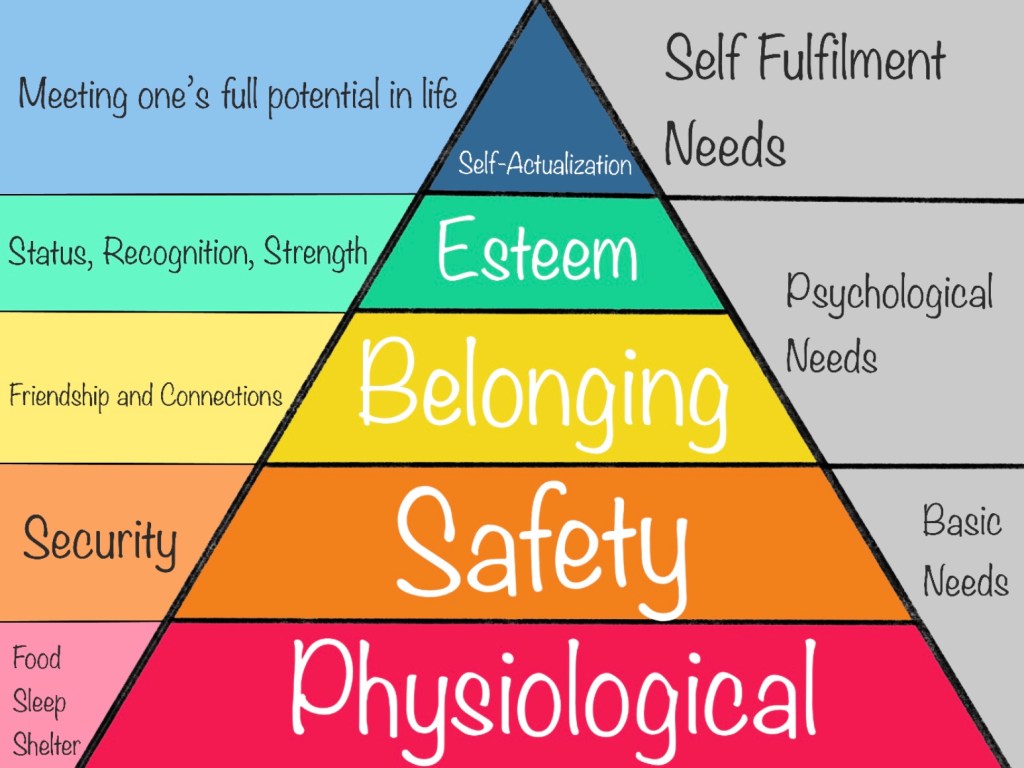
Maslow’s Hierarchy of Needs

Basic Needs

According to Maslow’s pyramid we will see that the bottom two levels make up the basic needs- physiological (food, water, shelter, rest…) and safety (security). When sharing this with my first year teacher I said that without those basic needs being met no student can learn. These needs are ones that you cannot say you will deal with later. These are the ones that you address first.

Physiology needs are ones that we should not put on teachers to meet, but we ask teachers to know their students well enough that if those basic needs are not being met then let someone know. Safety needs in the classroom are more than just asking if the room is physically safe (which is still extremely important) but are their procedures in place so the students knows what is expected of them when they come into the room? That security of knowing what to do in the classroom is essential and again, is not something that can be put off. You must establish your procedures, even if you end up tweaking them over time.

I always tell first year teachers that year one is the hardest and it will get better. So naturally, my teacher I visited with was worried because he is adding two new art classes next year and he was not sure how he will manage. The beauty of physiology and safety needs your “have to” for work, is those don’t change every year. You determine what works for you and get better and better each year at implementing them no matter what course you are teaching.

Growth Needs

Now, if we look at the next three tiers on the pyramid we see belonging (relationships, friends, connection), esteem (status, recognition, strength), and self-actualization (achieving full potential), this is where growth takes place. But remember, we cannot have growth without the first two needs being met. These three tiers will change each year as you have different students and how you meet their needs of belonging, esteem, and self-actualization will change, but once you have a firm grasp of implementing physiology and safety needs it will not feel so overwhelming.

So What Can You Do?

A great activity to determine how much time you are spending on each need is to track your time for a whole week and label each activity with which need is being met. The basic needs cannot be put off and must be addressed. These are the needs that no matter the class you are teaching once you have established what works for you then you can replicate with minor tweaks. Basic needs are also things that you can ask for support. If you are spending a lot of time addressing physiological needs then ask a counselor or administrator for help with these issues. If you are spending a lot of time on safety needs then visit with a veteran teacher to get tips and tricks that work well in the classroom. You do not have to find someone who teaches the same content as you, good classroom management looks similar throughout the school.

Once you have learned how to meet the basic needs of your students then creating a sense of belonging should be your focus and priority. Each year this will look different as your students and their needs will be unique, but a sense of belonging should always be a priority. While in your first year in education, it can be a challenge to learn how to make all students belong and establishing authentic connections in the classroom. Do not hesitate to visit with other teachers on how they build relationships and create an inclusive classroom environment.

So, in your first year of education if you put a focus on physiological, safety, and belonging needs of your students then you will be doing a great job. You will figure out what works for you and what works in your classroom. Year two you will get even better and year three even better than that. During this time is when you start to devote more of your time looking at esteem and self-actualization needs in your students.

Just remember, it is a lot and no one expects you to be an expert during your first year. Honestly, no one expects you to know everything at any point in your career. If you ever feel that you have learned everything there is to learn, then you have a fixed mindset which is not a good thing (I will save that for another post). Prioritize the have to haves your first year in the profession and know that the work you are doing will carry over for the rest of your career and that people are always here to help.

Classroom Observations: How to Make Them Worth Your Time

Classroom Observations: How to Make Them Worth Your Time

Lead learner, instructional leader, growth mindset–these are all words that should describe the administration team at any school. It is the job of administrators to help teachers grow in their role. The best way to do this is to actually be present in the classrooms through observations.

I want to pause a minute and reflect on my previous sentence, “actually be present in the classrooms”. Anyone who has been in a position of school leadership knows that a well-planned day can get upended within seconds of walking in the door. This is why it is so important to plan a protected time that, no matter what, you are able to get into classrooms. I will save how to structure your protected time in another blog, but now back to classroom observations! The purpose of this post is to provide a concise list to help remind administrators of best practices for classroom observations. I will provide links to additional posts that offer an in-depth look at these specific practices as they are written.

What is a good classroom observation?

There are a few key components for good classroom observations.

  • Being Present
  • Being Engaged
  • Looking for Specific Strategies
  • Knowing Teachers’ Strengths and Weaknesses
  • Purposeful, Specific, and Timely Feedback

Being Present

Administrators are busy. We have several things on our mind, and we are trying to figure out how to get them all finished by our deadlines.

But when it comes time to do a classroom observation, that observation must be the only thing on our mind. Be present in the moment, and give your teacher and students your full attention. As instructional leaders, we have a crucial role in promoting student learning, and effective observations and feedback are key components of achieving this goal.

I have started leaving my laptop in my office and going to my observations with a notebook and pen. If I am doing a formal observation, then this approach is not practical, but I have found that removing the temptation of checking emails, finishing up other work, or getting an idea while in a classroom and starting on a new task, I am able to present and notice the small details that build the culture of learning in each classroom.

Being Engaged

Not only should you be present in the moment of an observation, you must also fully engage with the classroom experience. Teachers spend a significant amount of time on all of the aspects of their lesson. Engage with each part and be ready to ask clarifying questions or give praise on specific components of the classroom environment.

This is a time to be critical. Try to decipher why the teacher has chosen the pacing of the lesson, why students are grouped in a certain way, or how each part of the lesson ties back to the essential learning targets of the unit. If you are not able to answer these questions, then they are great starting points to discuss with your teacher.

Looking for Specific Strategies

According to Dr. Jay Dostal in his book Value Added Feedback, administrators need to look for themes that can lead to teacher reflection. Look for themes and specific strategies in the classroom that can contribute to a deep and reflective conversation. This is when true growth on the teachers part takes place. If you are unable to identify specific strategies, then as an instructional leader, you must provide suggestions that may have worked well in the lesson and be ready to share resources. One of the most discouraging things an administrator can do is give feedback (“Why don’t you add more structured student talks in your classroom?”) without providing the tools or resources to support the teacher in implementing these strategies in the classroom.

Knowing Your Teacher’s Strengths and Weaknesses

Each year educators are asked to write Professional Growth Plans or PGPs. These plans can be viewed in one of two ways: checking off a box that the state or district is requiring or a time to reflect with your teacher. When reflecting we should ask teachers to identify what strengths they currently have and should continue to build upon and what weaknesses they need to improve on.

During observations look for the areas that you can provide guidance in as well as the skills the teacher already has. The best professional development I have attended are ones where I am learning from fellow educators. By knowing your teacher’s strengths and weaknesses you can continue to build your teacher up by showing off their strengths as well as providing support and resources for growth areas.

Purposeful, Specific, and Timely Feedback

Have you ever noticed that educators can be the worst students? Think about faculty meetings or conferences; how many teachers are on their phones or talking with their buddy while the presenter is speaking? In the same way, we ask teachers to provide their students with purposeful, specific, and timely feedback on assessments, so should administrators when doing classroom observations.

If I have my laptop with me, I will go ahead and type up my email to the teacher with their glow and grow as well as any questions I may have before I leave the classroom. If I have a notebook and pen, I make sure that before I head home for the day that I have sent teachers an email thanking them for their time and sharing my observations.

Failure- It’s a Good Thing?

Failure- It’s a Good Thing?

I recently reflected and blogged on my first few weeks as an administrator and one of my key points was the fact that I will make mistakes. Everyone makes mistakes, but each person has the choice to let the mistake/failure define who they are or to learn and grow from the experience.

I had the opportunity to participate in a breakout session at the AAEA summer conference and Dr. Gotcher asked the audience to share what failure meant to them. One person shared “Failure is only the next opportunity to succeed.”

This really hit home for me. As we go through this school year, trying to navigate COVID-19, I know there will be moments of failure. I want to choose to view each of those moments as just creating opportunities for success.

Now, saying that you will take your failures and turn them into opportunities is easier said that done. At least that is my personal experience. For this school year I am going to do these follow steps to try and make failures opportunities for success.

Community

Going at this career alone is never a good idea. Find your person that you can process through hard times and help keep perspective on the bigger picture.

Student Focused Vision

When you experience a failure, determine if what you were trying to do would be best for students. If it failed because it ultimately wasn’t what was best for students then walk away. If you still believe it is what is best for students then keep trying and reach out to those around you that can support your vision. As long as we keep our focus on what is best for students we can always turn opportunities into success.

Grace

I have to be willing to give myself grace. I have heard over and over the phrase “Grace before Grades”, but I think we can just say “Grace first”. Everyone will be going through a challenging time whether it is a student juggling school, with remote learning with siblings, while working a full time job to support their family; or parents who are staying up late at night after working all day to try and help their students with homework because their child is having a hard time adjusting to school again; or teachers who are so excited to see and love on their students but are also scared about their health and the health of their families. Grace must come into play for all parts of education this year.

I believe if I filter all of my experiences and reflections through these three steps then I will be able to take my failures and turn them into successes.


Three Promises I Make to My Children

Three Promises I Make to My Children

Parenting is tough, like really tough. I had no idea what I was signing up for 12 years ago when my son came into this world. I have made more mistakes than I care to share, but I have also experienced more joy than I thought possible. As time has gone on, I have been able to define my personal goals as a parent.

I tell my children regularly that their are three things that I must do. Every decision that I make can be traced back to these three jobs or promises that I have made to them.

As I look at my role as an educator I can apply these same promises to my students no matter the capacity to which I serve them.

For the sake of clarification- throughout the rest of this blog when I say “my children” or “children” I mean both my biological and students at school.

1. My promise to LOVE and show you love.

Keep in mind, these three promises are in no particular order, they are all equally important.

This first promise is to make sure my children grow up to know what love is, feeling loved, and learn how to appropriately love others.

Choose Love is a popular Social and Emotional Learning Curriculum that is being used around the country. The title says it all, choose love. I want to model this with my children that in all situations you have a choice and I hope they choose love. There will be times when we mess up and that is okay. It does not mean you are a bad person, but you need to own it, learn from it, and do better by choosing love the next time.

2. My promise to PROTECT you.

My daughter is a little dare devil. Throughout her life I cannot tell you how many times I have told her she cannot do something. The conversations goes like this;

“Why not mom? I want to.”

“I know you want to, but you cannot. It’s not safe because…”

As children get older the conversations will change from “you can’t run with scissors, its not safe” to “let’s talk about why you should not vape and how dangerous it is for you.”

Protecting children in a school setting can look different. It can be protecting students physically, such as having crisis plans in place to ensure the safety of all students. But protecting a child is no only from physical harm, but emotional, social, and mental harm as well. Just a few examples are cyber bullying, dealing with struggles of life in and outside of school, and equipping students with the skills needed to survive and thrive after school.

Letting children learn from mistakes is a part of growing up; therefore, make sure you can clearly identify what you are protecting them from and why this is not a good learning opportunity. If you cannot identify those, then you may actually be keeping a child from growing.

Continually reflect.

3. My promise to TEACH you how to be a GOOD HUMAN.

My husband and I say this often to our children- just be a good human. Be kind, be accepting, be generous, be selfless… the list go on.

If you notice, none of those attributes are political. I do not have to impose my beliefs on children to communicate how to be good. If anyone disagrees and thinks that being a good human needs to be addressed cautiously in the classroom, please feel free to write to me so we can start a dialogue.

Every day when I leave for work I tell my children at home “be a good human today.” I have said the same thing to my children at school as well. I hope when children see me they are able learn from my example of what it means to be a good human.

I also recognize that leading by example is not enough. The promise is not “to SHOW you how to be a good human.” It is to “TEACH how to be a good human.” Teaching how to be a good human must be intertwined with the daily learning at school.

Imagine an entire school where every person lived by that phrase- be a good human.


Yes, people make mistakes, but that is the beauty of school. Children get to learn and have loving adults in their lives to help guide them.

One of these promises alone will not do. I have to live by all three when I am parenting at home and as educator at school. If one fails, the overall well-being of the child is at risk.

The Power of a Positive Phone Call

The Power of a Positive Phone Call

March 16, 2020 is a day that I will always remember in my educational career. This day would be the first day of remote learning across the state of Arkansas which would last the entire 4th quarter. 9 weeks later, I am wrapping up the school year and taking a minute to reflect on the good, the bad, and the ugly.

As I try to identify the positives that I will carry with me one comes to mind first; the power of a positive phone call. As an educator I have had to make my fair share of phone calls, but I have not always made the time to start each year with a positive one for every student.

During this global pandemic I decided that I would not contact a single one of my ESL families about school work until I had a chance to just visit with them and see how they were doing. I wanted them to know I was here first and foremost for the well-being of their child. We could worry about academics after I knew the child was doing well. I have never had such positive reaction and strong parental involvement as I have had this quarter.

Now, I understand that parents had to be involved as their child was now doing school from home, but these phone calls really set the tone for the last 9 weeks. Each family understood I was there to come alongside them to help and not to just let them know all the areas they were lacking.

After this year I will make it a priority to always make that positive contact first. I recently accepted a job as an assistant principal and I believe I can continue this in my new role and hopefully encourage my team to join me in this quest!

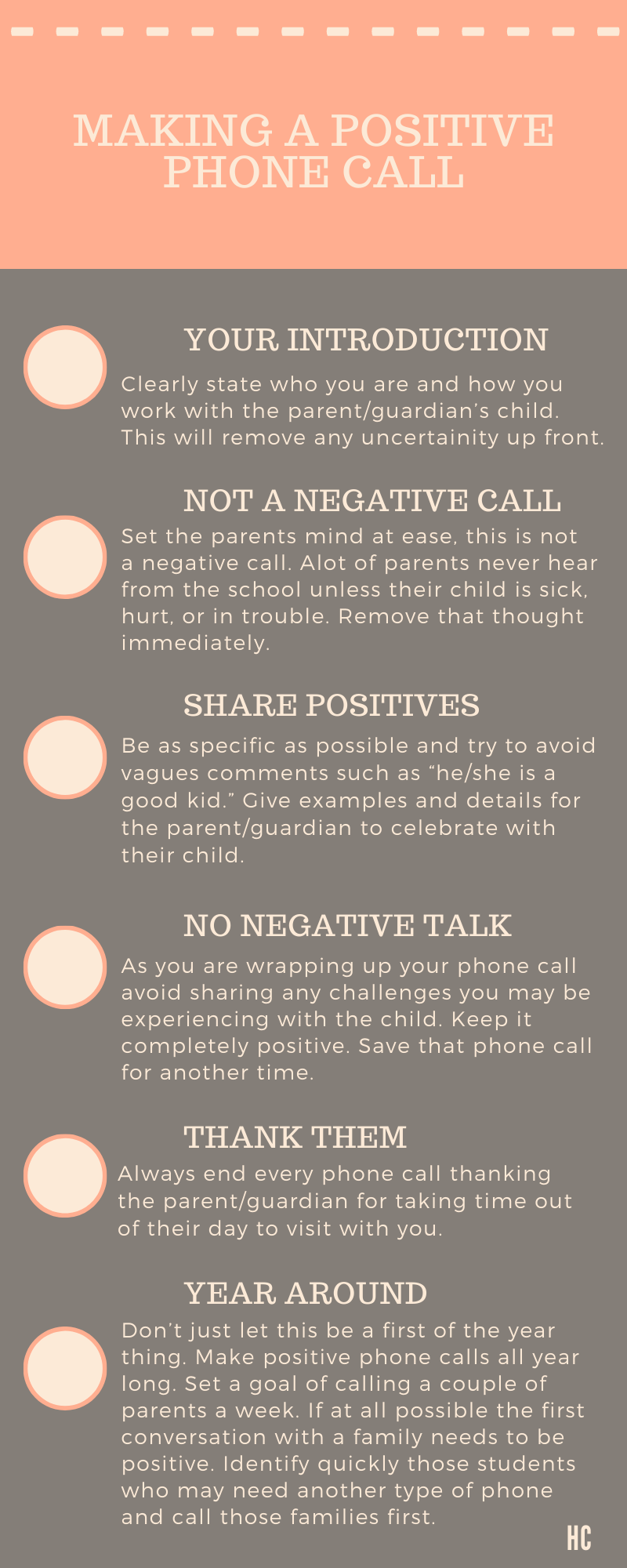
Check out this graphic on tips for making positive phone calls.


Educator’s Lifesaving Tip 4: Documenting

Educator’s Lifesaving Tip 4: Documenting


Document, document, document.

Oh, and document some more.

Has anyone else felt like they are documenting more than teaching? This is part of the new territory that comes with digital learning. I do not think I am alone in saying that it has been overwhelming. As I have gotten into a routine of things I wanted to share my process for documenting that works in the building and remotely.  

Data

Data

When documenting for any reason it is best to have some form of data that goes along with it. Anecdotal records are a great resource, but numbers can speak volumes when working on a team. Try to find a way to quantify your data before sharing. 

Concise

concise

Details are good, but too many can make it hard to read. Bullet points on a shared document or lists on Google Sheets/Excel spreadsheet can help create a nice system for getting the important details communicated. Now, if the details are important then definitely include. Just make sure it adds to the overall purpose of the documentation and does not take away from it. 

Share

people creative and brainstorm idea for business

I have always said that no students belongs to one teacher- when a student steps foot in a build that I work, then that child’s academic, emotional, physical, and mental well-being are the responsibility of every person there. When documenting it does no good if you are the only person who sees it. Find a system that works for your school in sharing data so that everyone can benefit from it. I have used Google Doc or Google Sheets to share with people and within my Google Drive I have created Priority Workspaces to keep all of my documentation organized. I do not know how I would be surviving working from home without these tools! 

CC’ed

cc

If you are documenting a situation that has happened and it includes another teacher’s name then it is best to include that teacher if possible. There may be scenarios where it is better to not include everyone involved and to allow another person to handle that conversation. If that is not the case, then give every person included in your documentation a heads up or carbon copy them to the email thread. 

Time

time

Right now documenting can feel like it is all you are doing. Find a process that works best for you. I have heard people who like to document everything at the end of their work day and that is how they wrap up. That does not work for me, I forget things too quickly. I currently spend the last 10 minutes of every hour documenting what I have done for the previous 50 minutes. This makes it so that I do not spend too much time just writing about my day and I do not forget any details I would want to include. Having a set time will help you never miss anything important. 

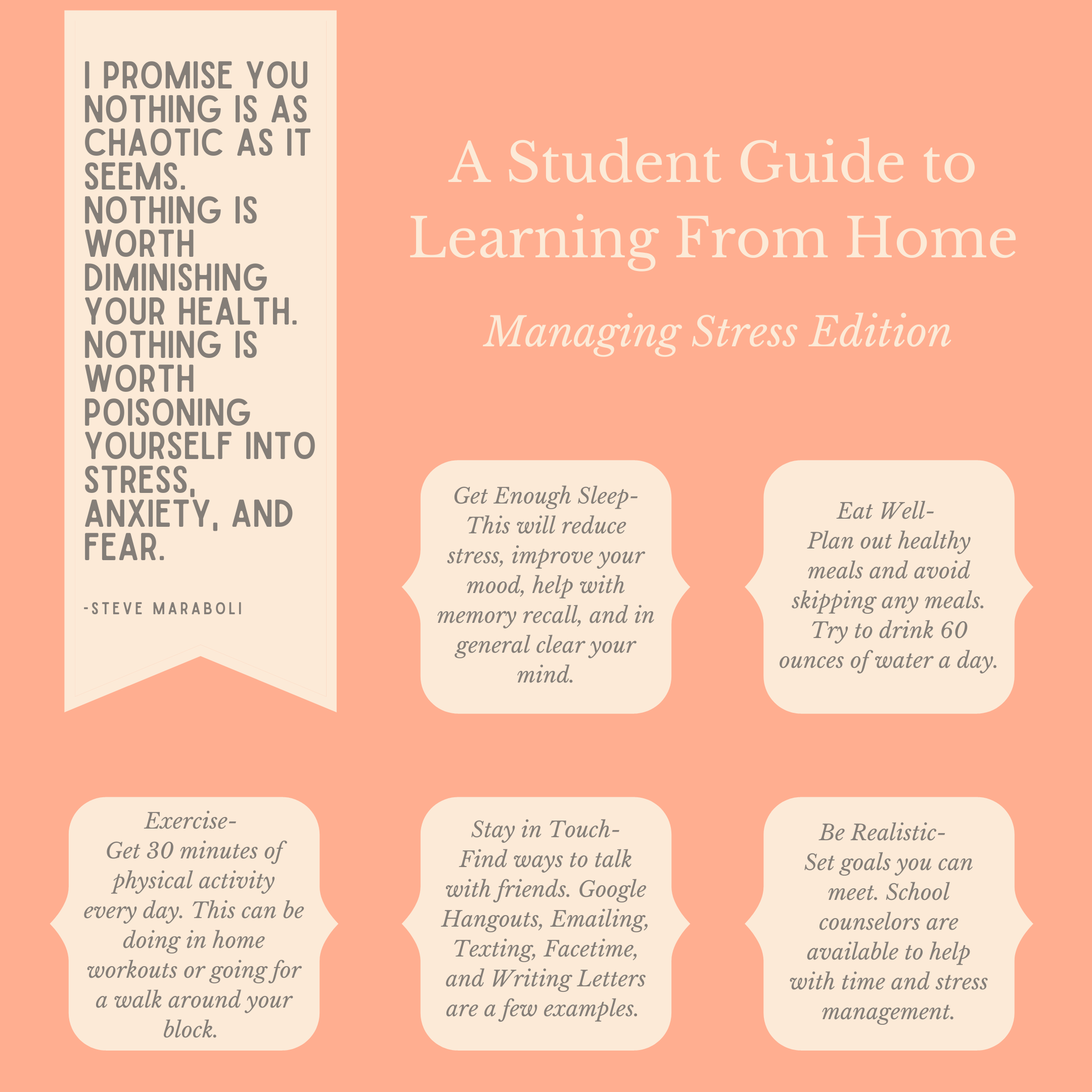
A Student Guide to Learning from Home: Managing Stress Edition

A Student Guide to Learning from Home: Managing Stress Edition

Today hit me hard.

I woke up, worked out, made my cup of coffee, got the kids up, made our breakfast, got dressed, and then walked 15 steps to my desk.

Real talk, as I sat there waiting for my computer to start up, I felt like crying.

I am an extrovert. Enneagram, I am a 7- the Adventurer. I love being an educator because I get my energy being with people and my passion is inspiring the next generation of movers and shakers of the world. Social distancing and isolation is a nightmare to me, but I am doing it. I know this is what is needed to help flatten the curve and to literally save lives.

As I started getting into my groove working I thought about the fact I have 30+ years of life experiences to prepare me for this; and yet, I am struggling big time! So how on earth are my 11-15 year old students handling life right now?!

Today led me to writing the next edition in “A Student Guide to Learning from Home- Managing Stress”. I want to give students tools to not only be successful academically during this time, but also stay emotionally, mentally, and physically healthy as well.

Please feel free to share any of the graphics I create and you can find my personal email on my contact page if you have questions or ideas. We are all in this together!


A Student Guide to Learning from Home: Communicating with Your Teacher Edition

A Student Guide to Learning from Home: Communicating with Your Teacher Edition

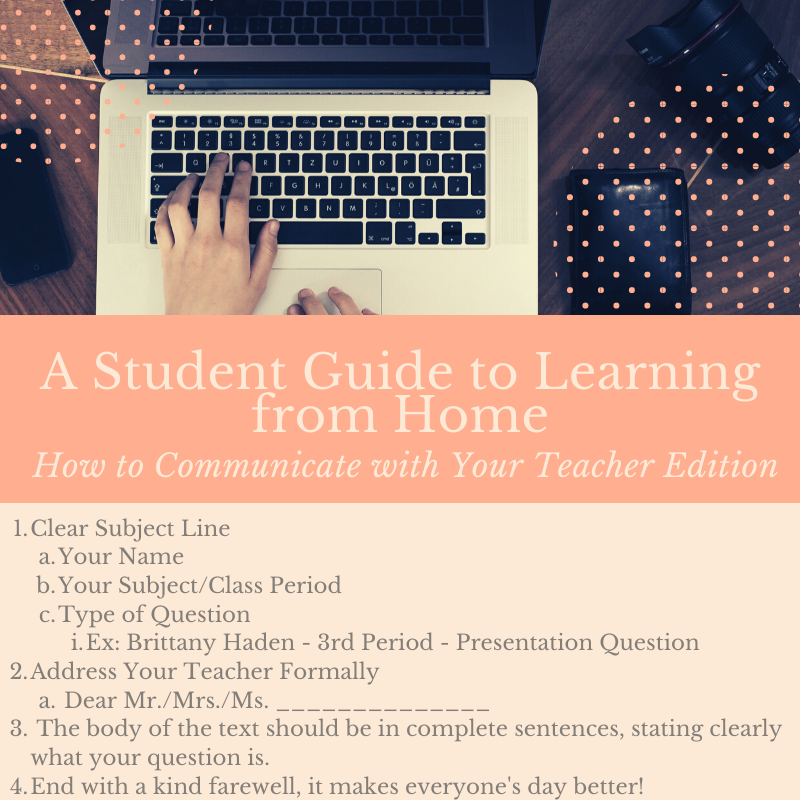
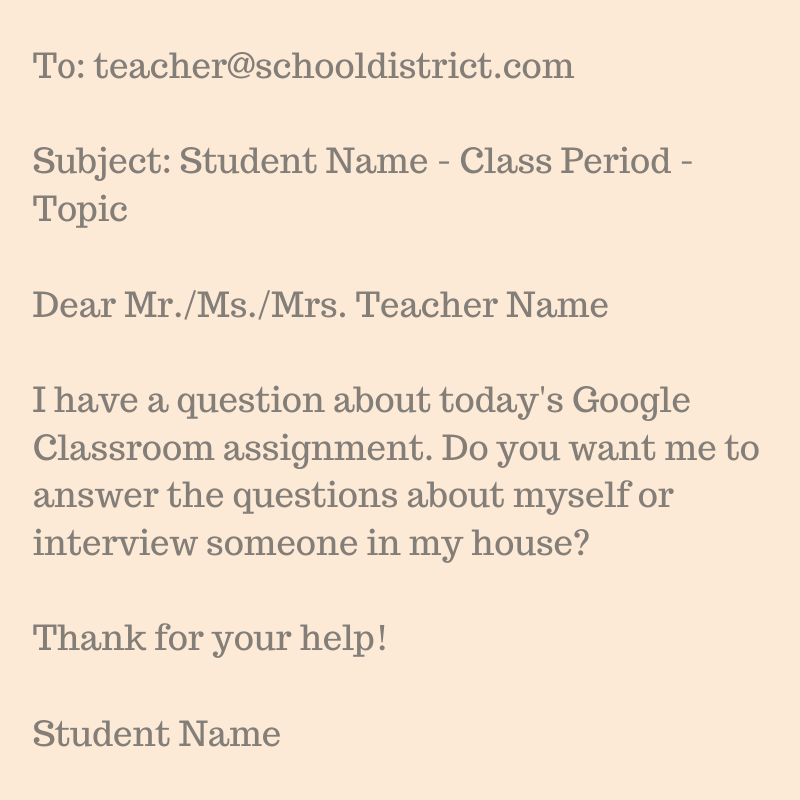
I have been getting lots of great feedback and requests for new editions and the top requested one was an example of how students can correctly email their teachers. I remembered back in my Keyboarding class we were taught how to make envelope labels and format a letter, but now we need students to know how to creat a subject line and write a short and concise email to their teachers. This is my motivation for “Communicating with Your Teacher Edition” of A Student Guide to Learning from Home.

This graphic is a two part edition. The first is an infographic with important information to help format your email and the second is an example.


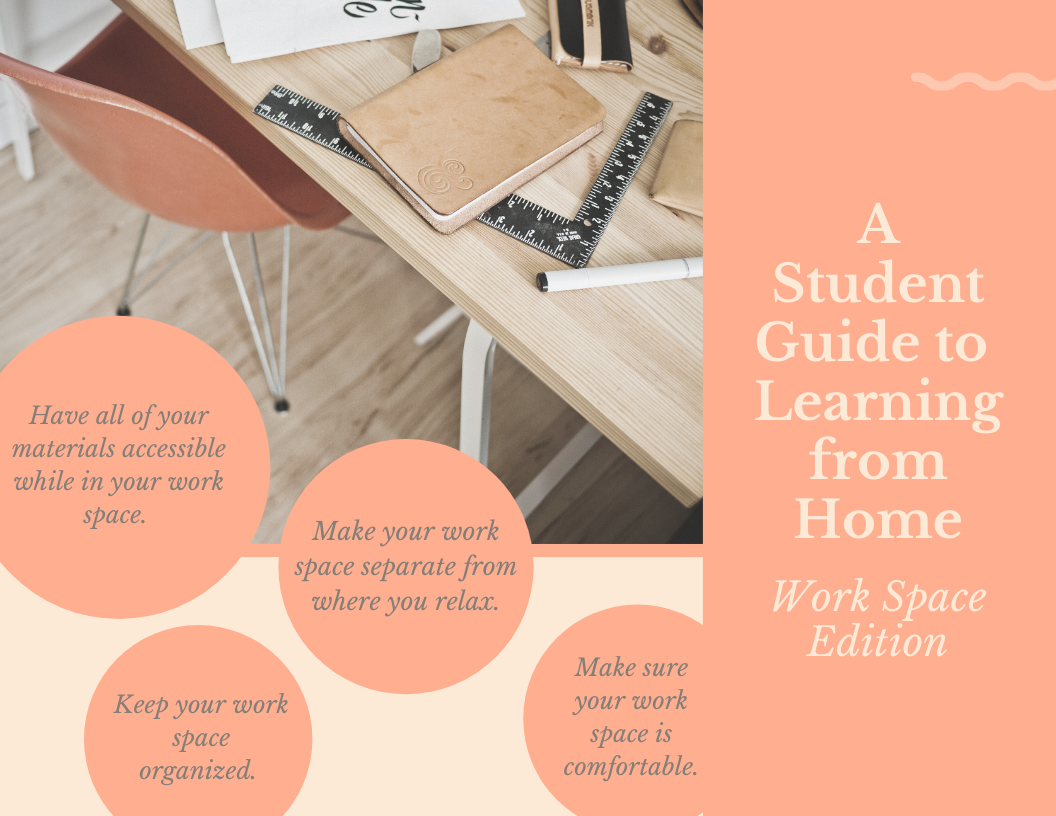
A Student Guide to Learning from Home: Work Space Edition

A Student Guide to Learning from Home: Work Space Edition

This is possibly one of the trickier ones, as people are limited with what they already have in their home. So look the latest infographic from the series “A Student Guide to Learning from Home” and do the best you can. It will make all the difference in the world when you have “your” space for working/learning.


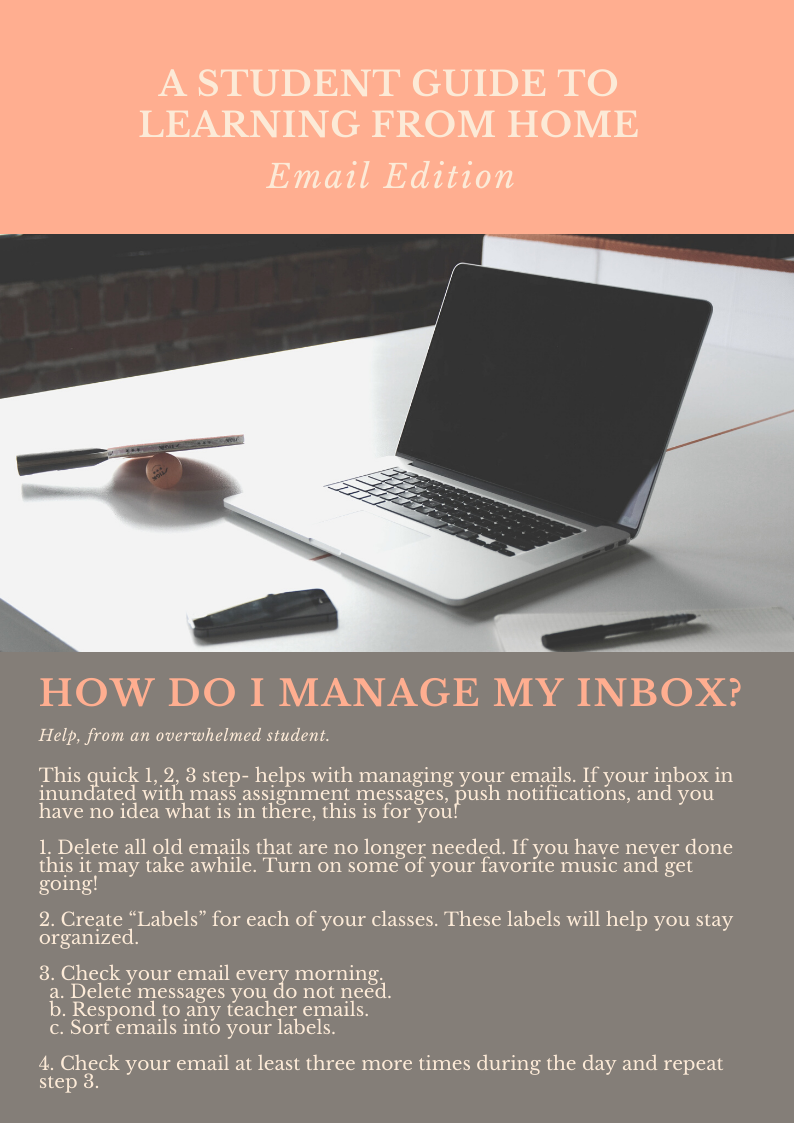
A Student Guide to Learning from Home: Email Edition

A Student Guide to Learning from Home: Email Edition

I had a slight panic attack when I looked at the thousands of unread emails in my 6th grade son’s inbox. He had asked for my help looking for an assignment from his teacher and surprisingly – insert eye roll – couldn’t find it. I realized that organizing and managing emails was not a skill he had yet, understandably so. Therefore, today infographic in my series is- Email Edition.