A Student Guide to Learning From Home: Routine Edition

A Student Guide to Learning From Home: Routine Edition

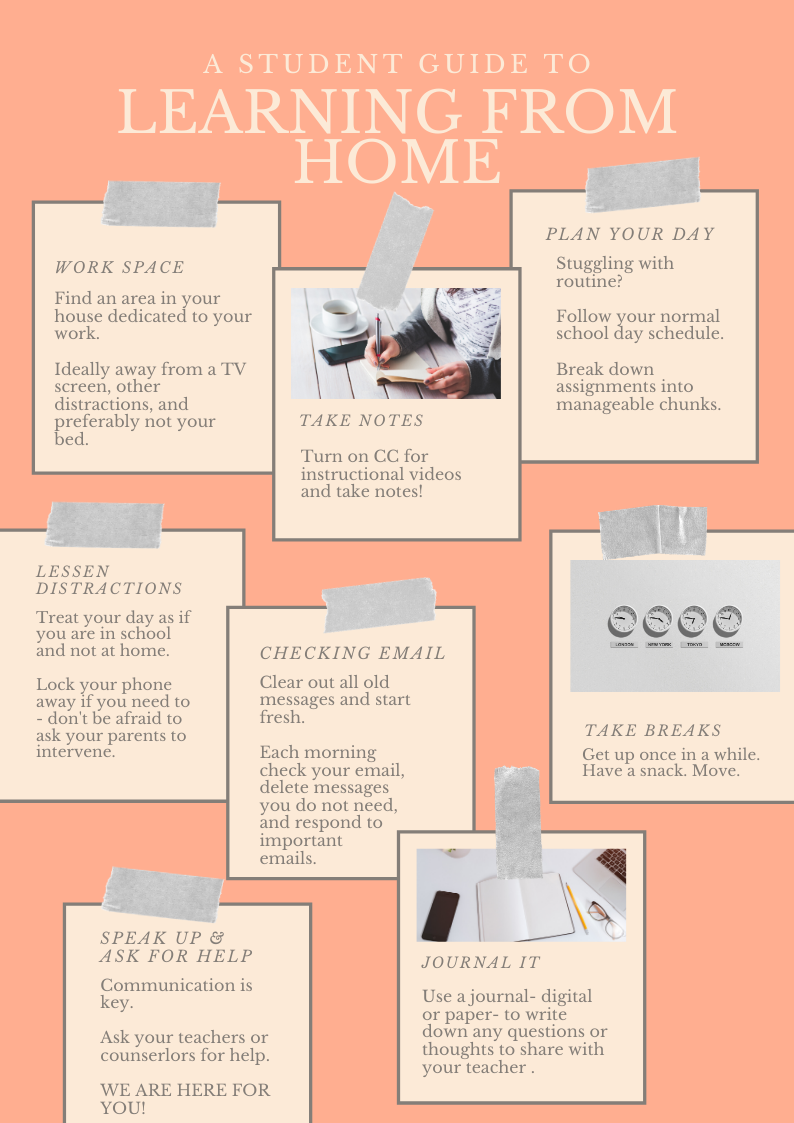
Today’s infographic is about creating a routine for your day of learning from home. Key components:

  • Make a clear separation from when you wake up and when you start working/learning
  • Take breaks- you are no good if you cannot focus anymore
  • Schedule time for physical activity/movement each day
  • Set realistic goals and chunk your assignments
  • Set a time to walk away from school/work at the end of the day and stick to it
  • Make your schedule your own! There is not a perfect routine that works for everyone, find what works for you!

A Student Guide to Learning From Home Series

A Student Guide to Learning From Home Series

2020 is unlike any year that I have experienced so far as an educator. I started a new role as an ESL Coordinator for a large school district in Northwest Arkansas. Learning a new role comes with its ups and downs and continual learning from typically more errors and than successes.

Then came March of 2020- COVID 19

Nothing could have prepared me or educators across the country for what was going to happen next. Schools shut down nationwide, even across the globe. School districts shifted overnight to distance learning with not time to prepare students- Kindergarten through 12th grade. Senior experience cut short; no spring sports, no prom, no graduation, no farewells to teachers and classmates… My heart still breaks for those students and their families.

Some schools are 1 to 1 and have the capability of sending devices home with students, others are not. Some students have WiFi access, other do not. There are several children who have IEPs, 504s, and LPACs and educators had to figure out how to meet those accommodations and modifications.

What I can say through everything is I have never been more proud of my career field, my coworkers, and my community. Teachers have come together globally to answer the question of how to best reach the needs of all students; not just academically, but physically and emotionally as well. District put together meal distribution plans so that no child would go hungry during school closures. Businesses ensured that every child would have what they needed- food, supplies, internet access, online resources…

I have been thinking about what I can do to contribute and decided to do a series for students and teachers called “A Student Guide to Learning from Home” with special edition graphics and videos throughout the next few weeks. I have been fortunate in this time of uncertainty because my husband is an independent contractor and has worked from home for the last 5 years. He helped me and our children create systems to help us while working and learning from home. So I have decided to take that information and share it with my fellow educators, parents, and children in hopes it can help each of you out as well.

This first graphic is an overview for learning from home. I will post more, so stay tuned! Enjoy 🙂

Educator’s Lifesaving Tip 3: Organization

Educator’s Lifesaving Tip 3: Organization

My original post was going to go something like, “Top 5 tips for being organized as an educator…” I planned this about 2 months ago. A lot has changed in 2 months.

Uncharted Territory

Overnight, teachers across the world were asked to change their delivery of instruction to digital learning. Every student was asked to begin a whole new level of self monitoring and pacing to complete weeks worth of education digitally. This is not even addressing those who do not have consistent access to internet, both teachers and students. Students who became full time babysitters while parents continued to work or teachers who began working from home while also having children of their own at home with them. Or the millions of people who may be scared as they watched people around them struggling with COVID-19.

What teachers have been asked to do is unprecedented.

As I sat down at my computer to write I told my husband I did not know if I wanted to write about digital learning. Yes, that is what people are searching for right now, but a large part of me is desperately missing normalcy. He suggested I got and search for inspiration; looking for a way to find normalcy in my career and yet staying relevant with what people are needing. So, naturally, I got on social media and this is what I saw:

“Let them sleep in”

“No need to get dressed for the day”

“Use screen time so you can get your things done.”

“Children should do no more than 2 hours of school a day while at home.”

“I can’t believe my child had an assignment for EVERY CLASS!”

And then there are the jokes that gave me a good laugh:

“There are parents all over America that are just realizing the teacher is NOT the problem.”

“Day 1 of homeschooling- trying to figure out how to get this kid transferred out of my class.”

“All these kids learning Common Core math, bout to learn how to “carry the one” from their new homeschool teacher.”

This last week has been a whirlwind and it is not over.

Without knowing exactly how long we will be doing digital learning, teachers have to plan for the worst, the rest of the school year, and hope for the best. Not only do teachers have to figure out how to continue to deliver instruction digitally and meeting the needs of all students with a variety of different circumstances, we also have to provide adequate resources to working parents.

In my household, I have a 9 year old daughter and a 12 year old son who have the privilege of spending A LOT of the foreseeable future with me. We are also fortunate that my husband is a blog writer and has mastered the art of working from home.

After day 1 he told me I would not survive. I woke up and immediately started working in the clothes I had slept in, I took lunch around 2:00pm and finished working after 7:00 that night. I am an extroverted work-aholic and I needed help. He sat me down and we came up with a game plan for me while working at home.

From this conversations my blog post has changed to “How to Stay Organized While Teaching From Home”

Tip 1: Morning Routine

He suggested I treat my mornings like any other morning.

  1. 30 Minute Workout
  2. Shower
  3. Wake Kids Up
  4. Breakfast/Coffee
  5. Look Over Today’s Schedule
  6. Brush Teeth
  7. Dress
  8. Leave the House

So besides step 8, I should try and follow the same routine (I definitely do not spend the same amount of time on step 7 as I did before). I following my routine the rest of the week and I can tell you from personal experience, I felt so much better having my mornings back.

Tip 2: Transitions

Transitions are an essential part of planning your day. How will you transition from activity to the next? What protocols do you have in place to help transitioning from PE back to the classroom? But now we are asking “How will I transition from one lesson planning, digital tool learning, answering emails to the next task?”

Schedule. Schedule. Schedule.

I even did this for the children. Each day my children have 1 hour for Literacy and 1 hour for Math. If they finish their assignment for the day in 30 minutes then they have to continue that topic for the remainder of the time. If it is Literacy they can read or do IXL for the rest of the time. For Math I have practice sheets like multiplication they can do or Prodigy/IXL.

I am doing the same. If I had an hour to answer emails or contact parents and I finish up after 45 minutes, I will spend the next 15 minutes learning about new tools and resources to make communication more beneficial during this time.

**My ESL people- currently learning about Talking Points. As I learning more I will let everyone know!

Create a schedule for the family and follow it. This will keep everyone sane!

Tip 3: Food

Social media is lit up with funny memes about gaining weight during this time and I completely understand. I want to snack. All. Day. Long. Even though I know I do not need to.

Again, think about being at school/work . When do you normally eat in those settings? Make it a part of your schedule to only eat during those time. This will help everyone in the house keep with some normalcy during otherwise potential chaos.

Tip 4: Work Space

This one may be more difficult if your house is not set up with an office. My house is not, but we did make the desk in the living my personal working area.

Having this specific space helps me feel like walking into my office. I have left my personal life at the door and I have stepped into my educator role. As I stated earlier, transitions are big and we have to have a way to distinguish when we are working and when we are home. When I am sitting at the desk everyone in this house knows I am working. When it is time for me to “leave work” I closed up my work station, put my books and computer away, and leave my desk. I am now home for the evening.

Tip 5: Personal Care

This last one may be the most important. As always, an educator can only be their best for students if we are taking care of ourselves. This still applies. Organize and establish times to take care of yourself. Here are a list of ways you can do this.

  • Coffee To-Go
  • Go on a Walk
  • Order Food To-Go
  • Online Therapy Sessions
  • Get a Good Night of Sleep
  • Read a Book- not for work
  • Do a Puzzle
  • Follow the Above Recommendations
    • Workspace
    • Normal Eating Time
    • Schedule- you and children
    • Routine
  • Be Easy on Yourself- we are all learning and we will all make mistakes. Guess what, it’s okay.

The one take away I want anyone who is reading this is- the more organized you are will not only make the transition to digital learning easier, but it will help establish positive habits that will carry over into every day work life. Schedules and routines are your best friends. Use them wisely.


Respect- The Key to Empowerment

Respect- The Key to Empowerment

“I will give respect when I get respect.”

“Yea!”

“I better get treated right before I even think about giving someone respect.”

I sat there puzzled, not quite knowing how to respond to this. I was in my classroom, end of spring semester, during our Advisory period doing a discussion with my 10th grade students on respect. At my school, we had incorporated the Choose Love Curriculum as our SEL curriculum and we did the lessons during Advisory. The school has Advisory classes that loop with students each year so I know them all quite well at this point.

As I was looking at the script that I was supposed to read and seeing the direction I was supposed to take this conversations in, yet, listening to where my students’ were taking it… well, they did not line up in the slightest. I was raised to respect my elders. Period. End of discussion. Yet, here was an entire group of 15 to 16 year olds who were adamant that my way of looking at respect was crazy. We continued the discussion with me trying to show them my side of the debate such as choosing kindness and love always. Sure, if someone had lost my respect then that was an entirely different story. However, why not start with giving the other person a chance? The students went on trying to get me to see their side- that people needed to earn respect first and so on and so forth.

When I got home that evening I told my husband about the debate, expecting him to side with me. Instead, I was left with wide eyes and opened mouth. He said, “good for them.” After staring at him for a good five seconds, I asked him to explain that response. He said why should elders be given respect automatically. Some of the worst people he knew were adults and some the best were children. He said you could withhold judgement of whether or not a person deserves your respect without being unkind. Not giving someone respect does not immediately mean you have to be a jerk to that person.

It was in that moment it clicked for me.

Along with being a teacher, I have two children of my own. I have always said that I wanted my children to grow up to be strong and independent, and it dawned on me, my thoughts of respect and how I wanted my children to grow up went against each other. I decided right then that I needed to change my way of thinking.

So, how have I found a way to empower all of my students in the classroom? By giving them the respect that they so desperately want and most of them deserve.

Prior to this discussion my Advisory class , I would say I was a “good” teacher. I designed engaging lessons, individualized instruction for specific student needs, and built relationships with each of my students as best as I could. The part that I was missing to truly empower my students was incorporating respect based on their definition, not mine. I have always respected my students in the sense that I treat them with kindness, fairness, and make decisions that I think are best for them.

Now I am viewing respect in a completely new way. I need to make sure I give my students a reason to respect me; I want to earn my students’ respect rather than simply not lose it. By wanting to earn respect from each of my students based on their terms, I have empowered each one of them to see their self-worth. When a child is able to see their self-worth, they are unstoppable and become the movers and shakers of the world.

After that night, I had changed my ways of thinking, so now it was time to figure out how to put this new concept into action. These are three ways I have found to earn my students respect, and in turn, empower them.

  1. Weekly feedback on my lessons- I am constantly giving students feedback on their work, so why not flip the script and give the students a voice to analyze my teaching each week? I have a sheet that has the weeks worth of bell work on it (or space to, I do not like them to work ahead) and at the end I have a box that allows them to share their glows, grows and feedback to me. On Friday, I go back over each of our lessons for the week so they can remember what all we done. On a daily basis, I encourage students at the end of each class to jot down any feedback they may want to share. I use this as a time to show students what constructive criticism is and how to use words in a kind and thoughtful way when giving feedback.
  2. Open and honest communication- some days are better than others. I have learned that if I am open with my students (within reason) then they tend to be more open and honest with me. This has led to me meeting the needs of my students better as well as showing them they are worth my time. There are some days that a student will need to go work in the hallway to be alone, so I let them. There are some days that a student needs to lay their head down for 30 minutes, so I let them. Then there are days that a student will come to me needing affirmation, so I tell them that they are strong and I am proud of them. Open and honest communication helps build that mutual respect and fosters a positive environment for all students.
  3. Goal setting- I can have my goals all day long for my students and that will not matter one bit. To really show students that I want to respect them and empower them I have to give them a say in their education. This takes time getting to know each one of my students. When I say goal setting, I do not just mean short term (which are also good). I mean really talking to my students about their future and what they want for their lives. By understanding their passion, I can help facilitate conversations in the classroom that will peak student interest, engage them, and allow them to take ownership in the classroom. I can show students why my course is relevant to their dreams and goals; I can incorporate technology that will be useful down the read to each of my students. We need to shift our thinking globally and long term- not just our subject and short term.

Each school, classroom, teacher, and student are different and how you find ways to empower students may look different than how I am able to. That is the beauty of education, it is specific to each child’s needs.

Educator’s Lifesaving Tip 2: Goal Setting

Educator’s Lifesaving Tip 2: Goal Setting

SMART Goals– A term that every educator has heard, and most likely multiple times at that. If you are new to education or live under a rock (not judging), SMART stands for Specific, Measurable, Attainable, Relevant, and Time-Bound. Every goal should meet these five criteria to be a SMART/good goal.

I remember years ago when I first started teaching, it felt like every meeting was centered around writing SMART goals. We would spend 40 minutes on the wording to make sure it was just right, but miss the purpose of the process of writing these goals in the first place. In this blog I am going to review the purpose of setting goals- whether those are personal or work goals and how to use the SMART goal format.

The Why and How to Setting Goals

In as basic of terms as I can put it– goals can bring a group of people together to develop a long-term mission and give short-term motivation along the way.  When people create goals it is a way to increase their self-confidence as they achieve those goals; either academical or personal. Whether you are creating goals for yourself or as a group it is essentially a three part process.

  1. Define your big picture. This can be curricular for content areas, school wide improvement plans, student academic growth plans, personal fitness plans, developing a positive habit… goals can be applied in infinite situations. Make sure to use the SMART goal format when creating your big picture plan as well as your short term goals.
  2. Next, after you have your picture clearly drawn out, break the picture down into smaller pieces and create targets that are essential to achieving your goal.
  3. Lastly, develop a way to track these small goals and cross them off once you have finished them. This contributes to the motivational aspect of setting goals. I personally like a physical representation such as a chart on a wall that I can check off targets as I accomplish them.

Specific

The more specific the goal is, the more likely you are to follow through on it. The S in SMART can also stand for Significant. Your goals should have a significant impact on the overall picture. Tip- it is better to make more small specific goals, than fewer vague goals.

Measurable

If you write a goal that does not have a way to track or collect data then you cannot measure how you are doing in terms of meeting that goal. In education this part is crucial and typically one of the hardest to meet. The goal “to increase positive culture at Haden High School by the end of the 2019-2020 school year” is a great thing to want, but how are you going to measure if you have achieved this goal? Developing the tool that will be used to measure the goal should be incorporated while creating the M of the SMART goal.

Attainable

Now is the time to do a gut check. Are you writing goals that are too attainable- you want to make sure you are successful so you do not challenge yourself or others enough? Or could you be writing goals that have the best intention, but are not realistic? The first can lead to mediocrity; whereas, the second can lead to frustration and a sense of failure.  Think of it this way, if you have never ran before then setting the goal of running a marathon in 6 months is not reasonable; however, setting a goal of running for 5 minutes straight after training for a year is most likely not challenging enough. This is the time to be rigorous, and yet realistic.

Relevant

I do not think I am speaking for myself when I say I do not want or like busy work. Every goal and target needs to be relevant towards the big picture. This part of the SMART goal is a good time to look at assignments in the classroom that you have always given and determine if you are doing the assignment because it is relevant or because it is just what you have always done? If you have a team that is having a hard time nailing down the relevant portion, it is probably because the big picture or the “why” has not been clearly defined or agreed upon.

Time-Bound

Every goal needs to have an end date to see if you achieved the goal or not. To simply say “I will live a healthier life” is neither time-bound or measurable. To even say “I will lose 20 pounds by running” covers all parts (kinda), but is not time-bound. How often are you going to run? When would you like to have the 20 pounds gone by? Placing a time element with a goal helps everyone on a team or PLC strive towards the end target with tenacity  to be successful by the deadline.

Extra Tips

  • Be flexible- if you realize a goal is not working- rewrite your goal.
  • Create checklists (check out my blog on checklists!)- this can be daily or weekly to help you stay on track.
  • State goals in a positive way.
  • Write down goals- make goals visible so you have a reminder of what you are striving for.
  • Celebrating- when you achieve a goal, celebrate it!!

Educator’s Lifesaving Tip 1: Checklists

Educator’s Lifesaving Tip 1: Checklists

I will never forget the day I got to shadow my favorite administrator. He had all sorts of tricks up his sleeve to build positive and lasting relationships with all students. You can read about my day in Shadowing an Administrator. One thing I wrote about is the checklist that Mr. Smith made first thing each morning. This checklist is what structured his entire day. Since then I have done the same thing and I cannot tell you enough how much it has saved my sanity!

I am now a firm believer in checklists for EVERYTHING, just ask my family. I have a checklist on my bathroom mirror for my morning routine, a checklist on the refrigerator of all the things I need to take to work with me for the day, my children have their morning routine checklist in their bedrooms… I think you get my point. Let me tell you specifically why checklists have saved my life.

Prioritizing My Day

When I create a checklist it begins as me jotting down all of the things I can think of. At work I do this as soon as I walk into my office. I gather all of my sticky notes from the day before, look at my emails, and check my Google Calendar. From there I begin to sort everything into priority. Most days I look at the absolutely overwhelming list and I know there is no way I will get them all finished. So I draw my line. I find where in my list I must get those things done the day. The rest of the list are things I would like to get done, but they can also wait for tomorrow. Making that decision first thing in the morning has taken so much pressure off of me. Trust me, I am always trying to get everything done, but at the end of the day as long as I have made it to that line, I am okay. By simply prioritizing my day I have allowed myself to fully focus on the task at hand and not worry about the rest of my day.

Fluidity

I am an ESL Coordinator for two schools. This means I travel back and forth regularly and have a lot going on. I cannot remember the last time that a day started where I thought it would and every class period went as planned. I am constantly getting emails from teachers asking for help or receiving a new student to complete testing and a LPAC for or a student comes running up because they have homework that is due in an hour and they need help right now! Just because I have a checklist does not mean I cannot add things in as they come. This is why I prefer a checklist to a planner. With a planner, you have specific times allotted for each task. This will not do for my role, whereas a checklist is more fluid and works within my schedule.

Documentation

As I said before, my role is a bit unique. I do not teach a set number of classes a day. Instead I have a list of tasks that need to be completed. I have found that creating and keeping checklists each day has helped me document exactly what I am doing with my time. I have never been asked to share how I am using my time, but I would certainly like to have the capability if I ever needed to. Keeping a checklist allows me to document and reflect back on my day easily without the frustration of trying to remember everything I did all on my own.

Give it a Try!

So give creating checklist a try! Begin with creating one that does not change each day, such as your morning routine and see if it helps you get ready a little more quickly. If your children struggle each morning and you are having to constantly holler at them to hurry up, give them a checklist. My daughter writes hers out on the bathroom mirror with an expo marker. You can even create a checklist that you keep on your board in the classroom, a list of things your students do everyday when they walk into the classroom. If you decide that checklists are as great as I think you will, try creating one for work each day. Don’t forget to prioritize your list!


Consequences versus Punishment

Consequences versus Punishment

“It is easier to build strong children than to repair broken men.”

This blog is based on the podcast “Consequences vs Punishment with High School Students” by Dr. Becky Bailey, the creator of Conscious Discipline.

Dr. Bailey begins the podcast by first defining the two words. Did you know that the word consequence has roots in Latin and French meaning “that which follows” or along the lines of growing out of an event or an effect. The legal definition of punishment is to afflict pain or a person losing something. As you can see, these two words are extremely different in definition, and yet are typically used interchangeably in education.

Through Conscious Discipline, students are taught that there are consequences for actions and to take responsibility for those ramifications rather than try to place blame and assign punishment for the behavior. This is a shift in mindset that we must make in education. In our role, we are always educating children. When we approach an issue from the standpoint of consequences so that the child understands this is the effect or the outcome of an event due to their actions rather than taking revenge on a child for disobeying, then child is able to take responsibility.

We should never give a child a punishment in school. The difference between punishment and consequences is the mindset that one views a situation. When a child is always afraid of the impending doom of a punishment then a child will not be able to learn in the classroom or change the problem behavior. Students (all people) go into a fight or flight brain mentality which inhibits the ability for them to learn from the situation.

Now that we know there is a significant difference between consequences and punishments, how do we implement consequences in the classroom? Let’s look at a systematic issue that I have seen in most buildings I have worked in so far.

Johnny decided to skip class one day. When he came to school the next day the principal called him into his office and gave him In School Suspension (ISS) for the day. Johnny goes to ISS and does not attend a single class all day. Let’s exam the consequence for Johnny, he did not want to go to the class he skipped and his consequence is to not got to class a second day… To me, Johnny was rewarded with not having to go to class again. This would be a scenario of a punishment rather than a consequence since it was not a natural event that grew from a situation. The punishment was removing social interaction and isolating the student.

A more appropriate consequence would be for Johnny to have to stay after school or come before school to make up the missed class time. The natural sequence of events would be that Johnny made a decision to skip his class time, and therefore has to make it up at a different time.

In the classroom we should look for naturally occurring consequences that come from a child’s decision. When a child chooses to not study for a test, the consequence is they get a low grade on the assessment. If it is a behavioral issue, such as a child acting out, we need to find out what the root cause for the behavior is and determine a natural consequence that matches the misbehavior. This is the whole purpose of Conscience Discipline, to be mindful of what the behavior is and why it has occurred. Once we understand why behavior has happened, then we need to show students that there are natural consequences for their decisions.

I want to make sure people understand, implementing consequences versus punishment does not mean that we as teachers turn our backs on bad behavior. Looking to use consequences in the classroom is working towards correcting the behavior and teaching the students long lasting changes. If a child is refusing to participate in the classroom activity simply sending them to the office for defiance will not result in any change. You will just get the satisfaction that the child got in trouble. Instead we should work to understand why the child is refusing to participate. Determining the why does not eliminate the need for a consequence, it just makes sure the consequence matches to behavior.

I am continuing my journey of understanding more about Conscious Discipline and look forward to helping my students socially and emotionally as well as academically. Here is the link for Conscious Discipline, give it a look and let me know what you think!


Happy Birthday to Me!

Happy Birthday to Me!

Today I turn 31, and all of my students know it. Which is against everything I learned in college; keep your work and personal life completely separate.

Anyone who knows me understands that it is not just a birthday, it’s birthday-month. This was quite a shock for my husband during our first year of marriage. When December 1 rolled around I expected the celebrations to begin! I am –not– so happy report that he has gotten me to just celebrate birthday weekend. Now, for someone who loves birthdays so much it was really hard for me not to share this with my students. So I did exactly what my professors told me not to do and told all 150 students of mine that December 10th was my birthday!

I did not expect anything from my students, I just wanted to them to know how excited I was about my birthday. To my surprise, on my 23rd birthday at Southwest Junior High School I walked into my classroom to find chocolates, Diet Dr. Peppers, and flowers waiting for me on my desk. Throughout the day I had more students bring little treats to celebrate me. I was overcome with how amazing my students are. I never told them about my obsession with Diet Dr. Peppers, they just picked up on it (probably the 5 a day I drink helped them out a bit). The students were so well behaved that day and seemed to genuinely enjoy taking the attention off of themselves and looking to the needs of another.

Reflecting back over the years I think it was good for students to see a working, successful adult enjoy their birthday. It is good for students to see adults having fun in a safe and professional way. Last year I turned 30 and rocked a fun 30th birthday t-shirt to school. The students loved how much joy I had with my birthday, and I hope it serves as a reminder that it is okay to still be a kid from time to time.

From that point on I decided that maybe it was okay to let the students in on a little bit of my life. Maybe I did not have to completely shut them out of what life as Mrs. Haden was like. This new idea was confirmed for me 4 years later when I began having health problems. Instead of explaining to my students a little bit of what was going on I thought I should shelter them from it and keep my poker face on every day at work. That was, until the day I went into AFib during class. I collapsed, got hooked up to a defibrillator, and rushed to the hospital. When I returned to work I explained to the students what was going on and how they could best help me if it ever happens again. Fast forward two years and there I was again, convulsing on the floor and my students stepped up in a big way. They called the nurse, cleared the pathway from the door to where I was, propped my head up on a backpack, and held my hand while we waited for help. They did not leave my side until adults had arrived.

All of this to say, students step up when they are asked to in every way, not just academically. As educators, we do not just teach students the standards of our content, but we also teach students how to be decent humans. My students got to witness me showing up every day with a smile on my face ready for work with a positive attitude. They did not just have a teacher tell them to have perseverance, they got to see it first hand because they knew parts of my story. My students get to take the focus and attention off of themselves to celebrate another person for one day a year (or a month if it were up to me). We talk about this generation of student not being as empathetic, kind, compassionate, or respectful; well lets give them the opportunity to learn those attributes and practice them.

Whether or not you choose to tell your students when your birthday is or that you may be having a hard time is completely up to each person. I have always been an open and real person with my students. That is what works for me. What I am trying to say is it is okay to let students know you are just a normal person who has their ups and downs. But that you show up every day to work because you love them and want them to be as successful as possible.

Building Relationships with the Unlikable Students

Building Relationships with the Unlikable Students

We all have had a student that we would rather be on someone else’s roster. Of course, this child is never absent and shows up 15 minutes before school to come straight to your room. There is something about the connection between you and that child that just does not click. So what can we do as teachers when we are struggling with difficult children in our classroom?

Structure

Having structure and routines in place not only help your classroom flow more smoothly, but also allow for you to set boundaries and expectations for more challenging students. When doing this, make sure you incorporate structures that you can follow through with fidelity. If the student sees you waiver with certain students or in certain situations then it will only continue to hurt your efforts in building that positive relationship.

Student Interest

Try finding one thing that each of your students likes or is passionate about. Once you have taken the time to find that passion, use it to build future lessons and strike up conversations that are non academic with students. This will help engage all students and lets them see you took the time to get to know them and then build the learning around their interests. To go the extra mile, if you discover that this particular difficult is involved in extra curricular activities, try to make the time to go watch that student. Not only are you showing the student how important they are, but you are also building that partnership with the parents.

Respect

This one has baffled me over the last 8 years in my educational career. Growing up I was always taught to respect adults, period. There was nothing more to it. This is not how this next generation is being raised. From the conversations I have had with students their approach is one of “I will give you respect, if you give me respect” and this applies to all ages. I am not saying one approach is better than another, but each are drastically different and teachers need to be aware of the changing viewpoints.

A teacher should always give students respect, no matter what. That means we never yell, we never put a student down, we never humiliate them, and we cannot have favorites. We are the adult and they are the child. We must always be the bigger person, even if we are having an awful day and just do not have the patience for it. We have to dig deep and find a way to treat all children the same. Every child, no matter how unlikable, deserve to know what it feels like to be valued and to feel respected. The school and classroom may be the only place that child can see respect in any form.

Understanding

When I say we need to be understanding it does not mean we have to force a conversation with a student to understand why we do not click. It can be hurtful when a student comes to you and says they learn better with another teacher, but we cannot take this personally. When a teacher tries to force an explanation from a student this can actually make the relationship worse. Make it clear to the student that you are there for them if they choose to talk, but let them have their space. We never want the student to grow resentful if we force them to talk before they are ready.

Listen

When a child is upset and lashing out, just listen. Do not argue back with them. Understand that their words are coming from a place of hurt and frustration, and not necessarily with you. After all, these are children, we must be the bigger person that offers grace and mercy.

What If…

Even if you follow each one of these pieces of advice, you may still have a student that you just do not like very much and that is okay. As long as you treat that child the same as every other child in your classroom and show them respect. The school year will come to an end and you will most likely get another student the following year that is equally as difficult to like. Just know that those students are probably the ones who need us the most.

Motivating Teachers as a Newbie

Motivating Teachers as a Newbie

I have had a nontraditional career so far as an educator: It all began in college. I started off as an art major, but as the first semester was coming to an end I began thinking about my financial responsibilities after graduation… which led to me to the drawing board for another degree. Next, I settled on becoming a nurse, that was, until I had my first class and passed out from the sight of blood. This time my college advisor made me really think about what I wanted to do with my life. The funny thing about that was that I was a single mother and had no idea what I was going to do when I got home, let alone, what I wanted to do for the rest of my life.

After looking through several course catalogs I finally settled on being an elementary teacher. I would love to say I got into teaching because I wanted to change lives and I loved children so much. But if I am being honest, I wanted to have the same schedule as my son and make a livable wage.

Fast forward to my senior year in college. Fall semester I was placed in a 4th grade classroom to observe and teach 3 lessons. This wasn’t too bad, I actually liked them this age of students. The Spring semester of my senior year I was placed in a kindergarten classroom. This was a time when I should be rejoicing about my upcoming graduation, and yet, I found myself in full blown panic mode. I did not like kindergartners and had decided I had a made a huge mistake! I could not teach elementary, but I felt it was too late to change my major now. In tears I went to my advisor and we looked through my transcript. Apparently, I had taken enough math classes as electives that I had a math minor. This meant I could get my teaching license and teach secondary math. The day was saved!

Instead of doing the traditional MAT program that the UofA-Fayetteville offered, I did a distance MAT program through UofA-Monticello. This program allowed me to have a job as a teacher in place of an internship. I needed this option as I was a single mother and needed to start making money immediately. Problem was, my undergraduate was early childhood education and I had only been in the classroom setting as “a teacher” for a total of 6 hours (not even 6 consecutive hours). I had not been in a secondary classroom besides 4 years prior when I was the high school student.

I was fortunate enough to find a school that took a risk with me and I am so thankful they did. I began my career in a junior high that housed 8th and 9th graders. As much as I loved my first job, I decided I should experience more grade levels to find my perfect fit. I am currently in my 8th year of teaching and I have been in 6 different buildings and 3 different districts.

Some people may see that and say that I just move around, but the reality is I was learning from each job. I was finding my purpose and pursuing it. I chose the degree so that I would have the same schedule as my children, but now I am passionate about education on a whole new level. My long term goals are to get my doctoral degree in educational policy writing and to work in DC. Each one of the buildings I have been in have given me a new perspective and an appreciation for the different ways to approach education. But, it also meant I have been “the new kid” 6 times so far in my career.

I have come to realize that my coworkers are not simply going to listen to me or seek my advice because I have taught for 8 years or the title I am given with my new job. They know nothing about me, so why should they? This year is the first time I have been out of the classroom. My first 7 years I was a math teacher and for the last 3 of those 7 years I was an ESL Caseload Manager as well. This year I am an ESL Coordinator for 2 buildings and my role is to collaborate with teachers to help our growing ESL population flourish in the general education classrooms.

So here I am, brand new district, brand new school, and brand new position. I started to think about the ways to gain my coworkers trust as a new person in the building and what I have learned so far this year about that process.

Relationships

I feel like I hear this word a lot in education; relationships. Relationships with students, relationships with coworkers, relationships with parents, relationships with the community… you get my point. It is all about relationships. But practically, what does that mean?

  1. Present- It is amazing how much being of an impact it makes just being visible at meetings, in between classes, during lunch… It can be so easy with this workload to recluse to your classroom and never get out. Building a relationship takes work, and you have to be present to put that work in.
  2. Reliable- In my specific role I cannot tell you how many times I get stopped in the hallway and asked about some time of paperwork, a student, an email… and if I tell a teacher that I will look into, but forget and never do, I have damaged that relationship. My way of keeping my self organized is to always have my phone with me so that when I am stopped in the hallways or I need to follow up on something I make a Google Calendar notification. I have quickly learned that if it is not in my calendar, it is probably not going to happen. Another person in the district that is in a similar role as me says she carries around a notepad with her at all times. That way if she is stopped she can jot down a quick note. So my advice is to find whatever way that works best of your to be reliable.
  3. Kind- This may seem elementary, but can go the furthest out of anything else. Education is not for the faint of heart. There are days that the students are awful, parents are mean, or administration has to have a tough conversation with you. We all need that one person that keeps you going. Maybe you do not have to say anything, but just by offering a quick smile to remind others that we are all in this together can help a person keep going. Be the person that is always positive and making the most out of life, that positivity will be contagious and people will remember you.

Knowledgeable

Educators are called to be life long learners. One of the best parts about having a mixed level of tenure in your staff is that everyone can learn from everyone. The teachers fresh out of college may have new strategies or different types of technology to bring to the table. The veteran teachers have years of wisdom of how to handle those situations that are not taught in a college classroom. Both sides of the spectrum are valuable and should be respected.

What you need to be careful with is that no one is expected to be an expert in all areas. No matter where you are in your career. It is okay to admit that you do not know, but that you will look into it. True collaboration and trust among coworkers with allow everyone to learn from one another with the focus always being on what is best for the students.

Trustworthy

Lastly, you must be trustworthy. I have already touched on this with the reliability aspect when you say you will do something, then do it. Trustworthy also means that people can rely on you to do what you are supposed to do when know one is watching (aka, integrity). Students and teachers talk. If you are lacking in any area it will not go unnoticed. It may for a while, but know that it will catch up to you.

Being trustworthy means keeping student information confidential. I think back on buildings where I have worked that at any given moment you could walk into the teacher lounge and hear teachers talking about students, gossiping really. This breaks down the trust among teachers. Even if a teacher is not participating in the conversations everyone knows who “talks” in the workroom. As a teacher, I never trusted those teachers with anything. I kept any issues I was having to myself. I wanted to show my students the respect they deserved by not talking about them in a negative way if possible. There are times when it is necessary to have tough conversations about students, but with a limited audience.

Be the teacher that can be trusted with any information and trusted to always do your work to the best of your ability. Couple this with being knowledgeable, humble, and building positive relationships will help you being a motivator in your school even as a newbie.